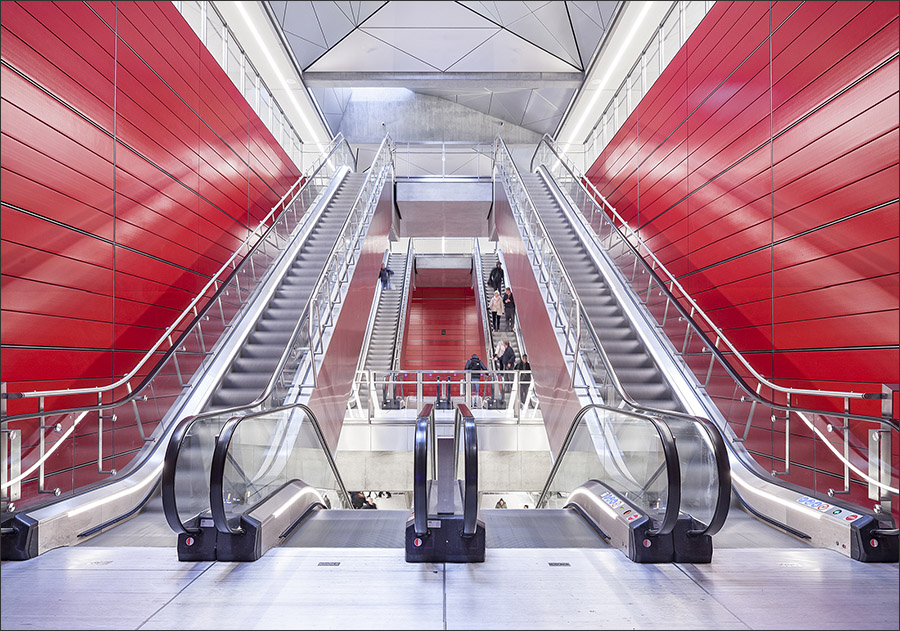
On 15 August 2020, the Danish Heath Authority issued regulations, that among other things, required enforcement of physical distancing, both onboard trains and in public facilities. This article describes the research that was conducted by a team at the Technical University of Denmark to study the impact of COVID-19 on the passenger flow in the Copenhagen Metro, using passenger flow data and station floorplan drawings as well as Bentley Legion software for simulation of pedestrian flow.
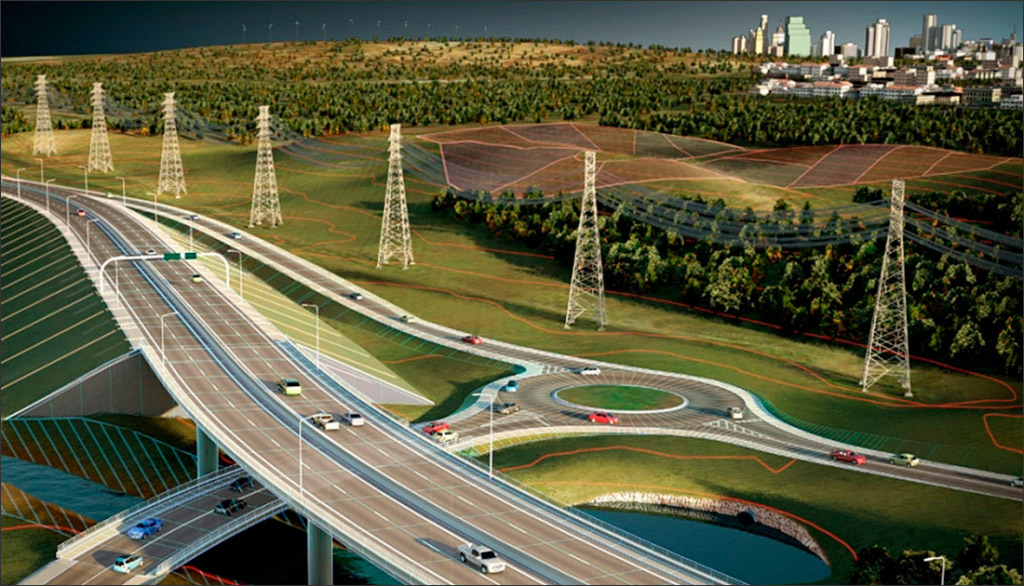
It has been close to seven years that I first wrote about the extension of the BIM concept of model-based design from the building domain to the infrastructure domain. At that time, Autodesk had recently launched InfraWorks as a “BIM-from-the-ground-up” infrastructure design application and was transitioning its flagship civil design application, Civil 3D, from being more CAD-like to BIM-like. Since then, there have been several developments in the field of BIM for infrastructure, including the software that is available for it, the implementation of BIM by infrastructure firms as well as government agencies, and the expansion of the IFC open standard for BIM to include infrastructure elements.
This article is focused on capturing the developments along the software front. As we will see, the field for BIM in infrastructure has expanded beyond the initial offerings that were limited to Autodesk and Bentley solutions. Let’s start by exploring these more recent offerings before going back to look at the solutions from Autodesk and Bentley for infrastructure design using BIM.
The biggest news out of this year’s annual GTC conference that NVIDIA — best known for its GPUs (graphics processing units) for gaming and professional markets such as AEC — puts together to showcase the latest developments in its products was the Omniverse. It is a 3D virtual world that can contain models created by many different people in many different applications in diverse locations around the world.
This article looks at the Omniverse in more detail, including what it is, how it works, and how it is being used by leading architectural firms like Foster + Partners and KPF (Kohn Pedersen Fox).
Over the past year, many industries have experienced unprecedented disruption due to the new challenges and uncertainties brought on by the pandemic. In construction, this has meant ongoing projects being paused, new project start dates being delayed, and stalled progress around the digital-driven evolution of some construction practices.
In this article, Frank Weiss, Senior Director, New Products, BIM and Innovation at Oracle Construction and Engineering discusses how the landscape of building information modelling (BIM) will evolve in 2021 and beyond and the four key areas the construction industry needs to address for a successful transition: the common data environment (CDE); data relevance and quality; the adoption of digital twins; and improvements to more industry standardization and openness.
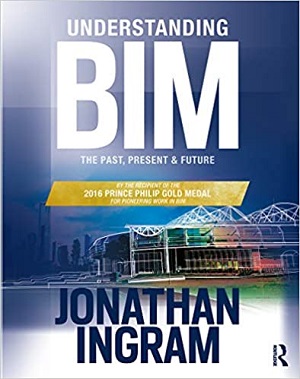
Given the large number of books on BIM that have been — and continue to be — published, what makes Understanding BIM stand out is that it is authored by someone who actually developed the precursor to modern BIM applications. This was an application called SONATA and it was developed by Jonathan Ingram — in true Silicon Valley start-up style — in his attic (rather than a garage as it would be in Silicon Valley!) in England. SONATA became REfLEX, which then became ProReflex, which was acquired by PTC (Parametric Technology Corporation), from which Revit emerged as a start-up, which was then acquired by Autodesk — and then of course, as they say, the rest is history. It is fascinating to be able to look back at the origins of BIM from someone who not only had a front row seat to the game, but who actually played it — and not just played it, but actually drafted many of its rules.
Sasaki, an interdisciplinary architecture, planning, landscape, and design firm with offices in Boston, Massachusetts, Shanghai, China, and Denver, Colorado, shares its perspective on AEC technology in this Firm Profile.
Since the start of the pandemic, employees have been working remotely and company leadership wanted to understand their space use options once it is safe to return to the office, recognizing this unique opportunity to rethink where and how their employees work. If, as a company, they want to continue working as they did pre-pandemic, how much additional real estate would they need to lease to accommodate growth? If they want to remain in their current space, in what ways would they need to change their current work model? To help answer some of these questions, Sasaki developed a web-based dashboard that allowed the client to test alternative solutions by adjusting any number of inputs.
It has been over 15 years since I took an in-depth look at the IFC (Industry Foundation Classes) open standard and my reason for doing so at that time was that with the increasing interest in BIM in the AEC community, “the issue of interoperability as a means to integrate the various model-based applications into a smooth and efficient workflow” had emerged to the forefront of professional attention. Here we are, all these years later, and the interoperability issue is still as critical as ever, if not more so. The number of applications for the AEC industry has exploded, and it is likely to continue to increase. We need all these applications to be able to work together in order for them to be able to do what they need to do — help AEC professionals design, construct, and operate buildings and infrastructure as quickly, efficiently, and cost-effectively as possible. And in order to work together, they need to be able to exchange the building data they are creating and using with each other freely using a common standard, which is what the IFC is.
In addition to the IFC, the industry organization, buildingSMART, that develops it also develops several additional standards including BCF (BIM Collaboration Format), MVD (Model View Definition), IDM (Information Delivery Manual), and bsDD (buildingSMART Data Dictionary). What these various standards are and what they do is the subject of this AECbytes article.
Robotics is still a relatively new addition to the ancient land surveying industry. This article by Jane Marsh, Editor-in-Chief of Environment.co, highlights the many benefits surveying robots bring to the industry, bringing it closer to a monumental shift. When surveying robots become standard, the industry could look entirely different than it does today.
This article by engineers Sorin Ficut and Dan Ferne of INTBS Romania highlights the practical benefits of using FineFIRE, a BIM software for fire protection design, through a real-world case study involving the storage capacity expansion of a bottling plant of Coca-Cola HBC S/E Europe in Timis, Romania.
FineFIRE is a flexible modeling tool for sprinkler installations, practically without any design limits. We can directly get (almost on a real-time basis) the pipe sizing results according to the standards, thus enabling engineers to focus on the substantial aspects of the design. Particularly for medium to large scale projects like the one presented in this article, FineFIRE is the ideal tool to study alternative design solutions/scenarios in order to reach the optimum one.
ZELUS describes the Phase One renovation of the New Orleans Superdome, for which it provided pre-construction services. The Superdome was originally built in the 1970s and has become one of the most iconic sports stadiums in the US. It remains the largest fixed-dome structure in the world.
Using the BIM as-built has proven mission-critical to this project. With a structure as complex, grand in scale, and iconic as the Superdome, everyone working on the project has to know what they’re getting into before construction begins.




 AECbytes Blog